
Wave of Light | October 15, 2025 Register Now
registration open!


64 | Two Losses, One Marriage: Holding On to Faith Through Grief | Tim & Yolanda Thomas
February 1, 2026
filed under

Ashley welcomes longtime friends Tim and Yolanda Thomas to the Cradled in Hope podcast to share their journey through back-to-back pregnancy losses and the long road of grief, healing, and hope that followed.
Tim and Yolanda share the stories of their daughters, Abundynce and Joyana, and speak candidly about what it was like to walk through compounded loss, unanswered questions, and seasons of deep darkness—both individually and as a married couple. With humility and grace, they reflect on how grief tested their faith, strained communication, and reshaped their understanding of suffering, while also drawing them into a deeper dependence on the sovereignty of God.
This episode offers a rare and compassionate look at grief from both a mother’s and a father’s perspective, addressing the realities of grieving differently in marriage, navigating church hurt, and learning how to honor the lives of babies in Heaven while still allowing joy to return.
In this episode, we discussed:
- Walking through compounded grief after back-to-back losses and the weight of unanswered questions
- Grieving differently as husband and wife—and learning to honor each other’s timelines
- How pregnancy and infant loss impact marriage, parenting, and family life
- Wrestling with God’s sovereignty and finding rest when answers don’t come
- The pain of church hurt, Christian clichés, and feeling unseen in grief
- Why “weeping with those who weep” matters more than fixing or explaining suffering
- Releasing guilt around “moving forward” and understanding that joy does not erase love or remembrance
- The eternal perspective: trusting that our babies are safely held in the arms of Jesus
Whether you are newly grieving, walking through loss as a couple, or seeking to better support someone who is suffering, this episode offers reassurance that healing is possible, that joy can return, and that God remains faithful even in the darkest seasons.
Full transcript below.
MEET OUR GUEST

Tim and Yolanda’s love story began in 1996, and they were happily married in 1997. Over the next 16 years, they welcomed three beautiful children before their daughters, Abundynce Faith and Joyana Reign, were born into Heaven in 2015. In 2017, the Lord blessed their family once more with the gift of a rainbow baby.
Since their first loss in March 2015, and through both the pain and joy of the past decade, the Thomas family has faithfully supported and served the ministry of Bridget’s Cradles through volunteering, giving, and attending events such as Wave of Light. Tim and Yolanda are deeply grateful to call the Opligers dear friends.

New episodes will be shared on the 1st of every month. Don’t miss a single episode…subscribe wherever you podcast!
Please also leave a review to help spread the message of hope with other grieving mommas!

MEET OUR HOST
Ashley Opliger is the Executive Director of Bridget’s Cradles, a nonprofit organization based in Wichita, Kansas that donates cradles to over 1,600 hospitals in all 50 states and comforts over 30,000 bereaved families a year.
Ashley is married to Matt and they have three children: Bridget (in Heaven), and two sons. She is a follower of Christ who desires to share the hope of Heaven with families grieving the loss of a baby.
Connect with Ashley:
Facebook /ashleyopliger
Instagram @ashleyopliger
Pinterest /ashleyopliger
www.ashleyopliger.com
Follow Bridget’s Cradles:
Facebook /bridgetscradles
Instagram @bridgetscradles
Pinterest /bridgetscradles
www.bridgetscradles.com
JOIN OUR FACEBOOK GROUP FOR GRIEVING MOMS
EPISODE TRANSCRIPT
Episode 64 | Two Losses, One Marriage: Holding On to Faith Through Grief
Ashley Opliger: [00:00:00] You’re listening to the Cradled in Hope Podcast. I’m your host, Ashley Opliger. I’m a wife, mom, and follower of Christ who founded Bridget’s Cradles, a ministry in memory of my daughter, Bridget, who was stillborn at 24 weeks. Our nonprofit donates knit and crocheted cradles to hospitals in all fifty states to hold babies born into Heaven.
I’m also the author of the book Cradled in Hope, a biblical guide for moms grieving miscarriage, stillbirth, or infant loss. This podcast shares the same name—and the same heart—as the book: to help you find the comfort, compassion, and healing of Jesus in the midst of deep sorrow.
Rooted in the hope of the Gospel, this podcast is a sacred space for your broken heart to land. Here, we are going to trust God’s promise to heal our hearts, restore our joy, and use our grief for good. With faith in Jesus and eyes fixed on Heaven, we do not have to grieve without hope. We believe that Jesus cradles us in hope while He cradles our babies in Heaven.
Welcome to the Cradled in Hope Podcast.
Ashley Opliger: [00:01:02] Welcome back to the Cradled in Hope Podcast. Today, I’m honored to welcome two very dear friends of mine, Tim and Yolanda Thomas. Tim and Yolanda have been part of the Bridget’s Cradles story from the very early days of our ministry. They are the parents of Abundynce and Joyana, two precious daughters in Heaven.
[00:01:20] Their story includes back-to-back losses, deep personal grief, strain and growth within marriage, church hurt, and ultimately a testimony of God’s faithfulness, healing, and hope over time. I’m so grateful you get to hear their story. Let’s dive in now.
Ashley Opliger: [00:01:38] Tim and Yolanda, it’s so wonderful to have you on the Cradled in Hope Podcast.
Yolanda Thomas: [00:01:42] Thank you. Thank you for having us.
Ashley Opliger: [00:01:43] Well, we have been friends for many years, and I’m going to let you share your story and how you got connected to Bridget’s Cradles and how our friendship has grown over the years. But I have just been so blessed by your friendship and your support of the ministry over the years, and have really gotten to know both you and Tim, and have so looked up to your marriage and been inspired in how you have walked through your grief journey with the Lord.
[00:02:11] And so I am very honored that our listeners are going to get to know both of you today and hear your story. So would you share about Abundynce and Joyana and your story of walking through pregnancy loss?
Yolanda Thomas: [00:02:24] Yeah. I was just thinking, Ashley, over the last couple of days, it’s amazing to me that really when I first heard about you was actually before anything happened with us.
[00:02:36] We were at our church, and a lady at our church asked us to pray for her neighbor, who was a young mom that was in the process of having a complicated pregnancy and in the end ended up losing that baby. And I later found out that mom that we were praying for even before I knew you was you.
Ashley Opliger: [00:02:54] Wow. I don’t think I knew that part.
Yolanda Thomas: [00:02:56] We knew your neighbor, and she went to church with us, and we were praying for you when you were carrying Bridget.
And then it was that December, then we found out that we were pregnant with Abundynce. And we were excited. We had three children and didn’t have any complications with any of our pregnancies beforehand.
[00:03:16] I loved being pregnant. And we were seeing a midwife at the time, and it was in March, we were going in for our 18-week update or checkup. And I had just started feeling what I thought were those flutter kicks that you start to feel at the very beginning, but they stopped. And in the back of my mind, I was trying to not be concerned, but there was just a little something in the back of my mind that just kind of wondered.
[00:03:44] And so when I mentioned that to my midwife, she right away said, “Well, let’s just go ahead and check you,” at the beginning of the appointment. And so I laid down on the table, and she went to find the heartbeat. And we had heard the heartbeat several times by this point.
[00:04:00] And I remember looking over at Tim, and his face was just one of bewilderment. He was trying to figure out what was going on, but she tried several different Dopplers and was not able to find the heartbeat. And so we were pretty much in shock. I don’t know if you remember that time.
Tim Thomas: [00:04:22] It’s obviously not a fun time to revisit.
Yolanda Thomas: [00:04:24] No, it’s not. It’s a hard thing to go through, and then it’s a hard thing to revisit. It’s a hard thing to remember.
[00:04:30] But anyway, so she had us go do an ultrasound, and they confirmed that our baby had already passed away. And so then it was thinking through the process of, “Now what? Now we have to deliver this precious baby.”
And just the thought of that, I really struggled with that. I remember just really struggling with that, and I was even thinking about how Jesus must have felt in the Garden because I was just searching, “Lord, is there any other way we can do this?”
[00:05:01] But He gave me peace and strength, and we went ahead and decided to stay with our midwife. And so we actually had to, we induced at home and delivered at home. And then our midwife came and tended to me and assisted and found out that Abundynce had Amniotic Band Syndrome, which is, I don’t know what kind of strings, but there’s some strings were attached to her fingers and her hand, and then these strings eventually wrapped around her umbilical cord, and that cut off her lifeline.
So I think I had started to feel her move, but then the process of the band wrapping around her umbilical cord is what took her from us. And so that was really hard.
[00:05:51] But our midwife had just heard, I think, about Bridget’s Cradles. Abundynce was born on March 13th, 2015, and our midwife thought she had heard about a ministry that was trying to reach babies that were born in the second trimester with these cradles. And so I remember she had this cradle, and it was just the most beautiful thing I’d ever seen, and it really helped us be able to hold Abundynce and take pictures, and that was a really special thing. You can talk to …
Tim Thomas: [00:06:24] Yeah, I think this is the part that, I’ve been quoted on this several times, but it was hard because here you have this precious little baby that’s perfect in every way, so here we had this cradle and it just represented the warmth and a way to hold this cold body that we were grieving over of our precious baby girl. And so it was just truly special.
[00:06:49] The cradle to this day is just gorgeous. We cherish it. It has a special place in our hearts, but I think it just was a symbol, and we’ve thought about it too, as a tangible evidence of almost like God carrying or holding her in His hands. So it was very precious and it meant a lot to us.
Yolanda Thomas: [00:07:10] Yeah. So Mikaydon, my oldest daughter, and I started volunteering with Bridget’s Cradles, and that was a really healing thing for me to be around other moms that were grieving the loss of their babies. And so Mikaydon started crocheting, and she learned to make the cradles and the prayer squares, and so that was a really neat thing for her to get involved with.
[00:07:32] And it really wasn’t too long after we went through that process that we were actually able to get pregnant pretty quickly after that. And so this time I was 14 weeks with Joyana, and again, it was very similar. I went to an appointment, and they searched for the heartbeat and couldn’t find it.
[00:07:56] This time I was by myself, and so I called Tim, and he came to meet me, and I think both of us were dreading the whole thing. I mean, we had been through it once, and we were devastated the first time, and now were faced with it again. And it was just that much harder.
Tim Thomas: [00:08:19] Coming off of three no-issue pregnancies. And we understand that this podcast goes out to many different people in many different stations of life, and some have struggled to get pregnant and possibly have lost their first – maybe in their mind they’re even thinking only – child, and so they’re dealing with things on a certain level. We were coming off of it pretty raw from the first one.
[00:08:46] Speaking for myself, I’m an engineer, so I like answers, and so having an answer to what happened with Abundynce was not easy, but at least there was some logic to it, and I could reason that out in my mind. But with Joyana, we really didn’t have any answers, and so that was difficult.
We had felt that the Lord was calling us to have more children. There’s a whole story behind that in and of itself. But in essence, we began really questioning why we would have that leading or that calling, and then He would be choosing to take these children to Heaven right away. So that was a real struggle. So we really hit it lower the second time, I think.
Yolanda Thomas: [00:09:30] Yeah, and really going back in my childhood, I actually was a sibling to a baby that went to Heaven early. When I was eight years old, my mom carried a baby. She struggled with infertility for about eight years and then finally got pregnant. And then she hemorrhaged and almost died.
And my brother, she carried my brother for seven months, and then he went to be with the Lord. And I remember that being a very pivotal time in my childhood because my dad was very angry and my mom was very sad for a long time.
[00:10:01] And I remember thinking when Abundynce went to Heaven that it was the only time in my life that I was thankful that my mom wasn’t here to experience that. And it was actually her gain, in this case. It was my loss, but it was her gain, and I was thankful that she didn’t have to be here to experience those losses again with Abundynce and Joyana.
Tim Thomas: [00:10:23] I don’t know how much you want us to talk about how long we wallowed in our grief, because it was very difficult, I think, even more so with Joyana.
Yolanda Thomas: [00:10:31] Yeah, I think especially with Joyana, because we both had experienced the loss the first time, we were both dreading going through the whole thing again.
[00:10:39] And I think to some degree I felt or I sensed that Tim was trying to avoid that because he knew how hard that was. And for me, it was even worse because I was that much deeper in this grief of back-to-back losses and, you know, “I’m getting older. Are we going to be able to be blessed with another baby?” We just didn’t know.
Tim Thomas: [00:11:02] Yeah. So there was some stress in our marriage at that point in time. I wouldn’t say like a major issue, but it was a situation of just misunderstanding. I think I was dealing with the grief in a completely different way than Yolanda was, and it felt to her that I was absent, but I wasn’t trying to be. I just was in a deeper spot, and it was very difficult just to deal with it.
[00:11:29] I never really got gravely mad at God or completely … I just questioned, I think just very much naturally to anyone that experiences this that has a relationship with the Lord, just like Job. I mean, “What? What are you doing, Lord? I do not understand the good in this. I don’t understand how Your plan is better here.”
[00:11:51] It was a difficult time. I don’t even remember all of it, but I know that I didn’t verbalize as much as I had during Abundynce. I don’t feel like I really kept it inside, because if Yolanda talked to me or whatever, I would talk about it. I just dreaded it.
And I kind of think I knew it was going to be a process, obviously, that I wasn’t looking forward to. But I was just kind of like not willing to take on the process, but just the length of the pain and knowing what she was going to be going through, I knew that our lives for some time weren’t going to be normal.
And in all honesty, they’ll never be “normal”. You find a new normal. But there is definitely a healing and a hope that comes from this, so we don’t want to leave it in this despair, but we did go through a very “dry bones” type of a time.
Yolanda Thomas: [00:12:42] That was a very dark time, I think. I just remember being very sad and was hard to trust the Lord, to see what good was going to come from it.
Tim Thomas: [00:12:50] Right. And I think even to those people that might be walking this journey, something to consider is we still did have three living children, and I don’t know that we were great parents during that time.
[00:13:03] Our kids, especially our older two, would tell you that was definitely one of the most difficult times of their childhood. And they felt the loss too, and they wanted the siblings, and so it was a family grieving process.
Yolanda Thomas: [00:13:17] Mm-hmm. Yeah, so Joyana was born on October 10th, 2015, and her delivery was a lot harder to just, physically and emotionally, I remember during that time was the first Wave of Light. And I remember going to that right after.
October 15th is the Wave of Light, and it was very hard. But it was good because I could see that other families were also going through the same grief, and so that was comforting in some way to know that we were not alone in that. And so the Wave of Light has been a blessing each year that we have gone and participated in that.
Ashley Opliger: [00:13:57] Thank you for saying that, and I’m just so sorry for everything you’ve been through. I want to come back to the cradle for Abundynce because I remember picking the cradle out for her.
We are typically in hospitals, and so we don’t have many doulas and midwives that have our cradles. And so when your midwife reached out to me personally to tell me about you, I went into Bridget’s nursery at the time, because this was literally, I mean, Bridget was born in October of 2014, and then Abundynce was in 2015. So this was in the first year of being a ministry, and everything was in her empty nursery.
[00:14:36] So I remember going and picking out a cradle and giving it to your midwife, and later on you shared with me how much you loved the colors and the gold accents that I had picked out for you. And I just felt like that was a God thing, that He knew exactly what your hearts needed and what was perfect for her.
[00:14:55] And just to think that after that Mikaydon had learned to crochet and then had actually crocheted the cradle for Joyana, and that she was able to make that. Of course, that was not something you expected or wanted, and the compounded grief of walking through loss after loss, and you had also lost your mother, as you shared.
[00:15:14] And so there’s just so much grief in your life, and I completely resonate with how dark and hard that season is, and I’m glad that you honestly shared that because I think sometimes, especially in Christian podcasts, we talk about the hope of the Gospel and we talk about Heaven, and all of that is true.
[00:15:38] Simultaneously, though, we are experiencing deep grief and pain. And I think when we gloss over the fact that there is real suffering and real pain that we’re walking through, it kind of dilutes the power of the Gospel and how grateful we are for the Resurrection and what’s to come.
But it’s really important to share how hard and heavy it is, especially in marriage, when most likely two people are going to grieve differently. And that’s very common in marriages between husbands and wives, not just the difference between men and women, but also in different personalities. That’s something Matt and I have talked a lot about.
So would you mind sharing how each of you grieved and how you learned to fix that misunderstanding that you shared about, that you each were grieving differently and thinking one thing of the other person, and how you were able to communicate and learn to respect and honor each other’s grief?
Yolanda Thomas: [00:16:32] Well, I have to say I’m very blessed with a sensitive husband, and so when we lost Abundynce, again, I felt like we were very much grieving together, and we were on the same page.
Tim likes to work with his hands, so he went out and built a beautiful arbor for Abundynce, and we planted a little garden, and so it was a nice, peaceful place that we could go and just remember her and honor her and kind of memorialize her.
[00:17:00] I like to work with pictures and video, and so my grief process was working, making a memory book and a video to the song I Will Carry You. And then also, Tim was very supportive of Bridget’s Cradles and the work nights that we would go to Mikaydon and I would come and do the work nights. And I went to a support group at a church and that was helpful.
[00:17:26] And so I think, especially the first time through, we worked through it all together. And then I think just understanding that we were processing the second loss a little bit differently, it took a little bit of time to have that register.
But one thing I will say that I really appreciated, that Tim, I always knew that he was in my corner. Like we had some struggles at church and some different things; even though he didn’t maybe understand the depth of my pain and my grief, I always felt like he had my back.
And so even when I felt like I couldn’t defend myself, I had struggles with some close relationships, and people didn’t quite understand. I think they saw me walk the grief that I experienced with my mom and maybe they expected the grief of my babies to be the same, and it wasn’t. It just was very different.
[00:18:23] And I think that’s hard for people to understand and grasp, and so I just always knew that he was very supportive of me, even when he didn’t quite understand what I was going through, and I was really appreciative of that.
Tim Thomas: [00:18:36] Right. So several things that I was thinking about with regard to what she was saying is that, as difficult as it is, we all know that men and women are different. And that extends in all sorts of different ways, and it plays out in all sorts of different ways.
But especially with Joyana on our second loss, I think initially, obviously, we’ve mentioned that it was going to be very painful, and we both knew we were getting ready to embark on another painful journey. But I think I kind of had to realize and relearn that timelines are also different.
And so I’m not saying that my grief healed quicker. What I am saying is that I think initially I dealt with some of the initial shock and trauma of it maybe better, but then long term, I was still dealing with it, where with Yolanda, some of the first weeks, and it was a long process, but she was very down, almost seemingly inconsolable down.
[00:19:39] And that’s hard as a husband when you feel like you want to help problem-solve and you can’t really do anything for your wife. And so you have to be real about your emotions. And sometimes you almost get frustrated, because you’re like, “Just snap out of it and function with the daily needs of life.”
[00:19:57] But I had to step back and realize, “She’s physically hurting, hormonally, things are going on, and emotionally she’s just deeply scarred and hurt.” And so I think there was some of that, me learning to try to be patient and have maybe a longer timeline of what I would think.
[00:20:20] And then I think as we healed and as we walked the journey with Joyana, I realized how there were definitely some areas where I had probably pushed some of the pain down in a little deeper, just because I was trying to have the role of helping the family function during that time a little bit. And so at some point you have to deal with those things.
[00:20:39] And we did get better together, and that’s a process. And I’m reminded of the movie Courageous, if any of you have seen it. But you’re going to have those days when you look at each other, and you’re like, “Yeah, we had a good day today.” And then you’re going to have those days, it wasn’t such a good day, and you just have to get through it.
And so I think you’ve got to allow yourself the freedom to have good days and bad days and not have expectations that you’re going to get to a good day and every day after is going to be a good day, because that’s just not how it is.
Ashley Opliger: [00:21:07] Yeah, you’re absolutely right. And Tim, you said something really important is that our timelines are going to be different and we’re going to grieve differently. And it is so common, especially for men, to push the pain down because they want to function and lead the family.
[00:21:24] And so there’s this kind of misconception or this sense of responsibility of, “I know my wife is suffering and struggling, so I better be strong to hold all of us up.” So what would your advice be for allowing the pain to surface and allowing yourself to feel, still leading your family, but finding healthy ways to bring your grief to the surface and face the pain head on, and so maybe just some things that worked for you or some advice that you would have for other men that might be listening?
Tim Thomas: [00:21:57] Yeah, that’s probably a really hard answer, actually, because men are programmed differently. And some men are able to have, let’s say, a friend or someone that they already have a close relationship with that they can tie in together, and they can talk about those things.
[00:22:13] And then there’s many men out there that either don’t have that relationship or haven’t developed that. And as much as I’d like to think I have a lot of close relationships, a lot of times when Yolanda and I will sit and actually think about it, we’re like, “Well, we’re each other’s best friend.” I don’t have a lot of super close friends, and during that time, I had some decently close friends at church, and we talked about it some. But honestly, I don’t know that I have a great answer, which isn’t what you want to hear necessarily.
[00:22:41] But I think, of course, trying to stay in the Word, trying to stay in prayer, and then just for me, giving myself freedom to express those feelings of grief when they surfaced.
And so I can specifically remember, because I like to play guitar, I can specifically remember playing a couple of worship songs, and just sometimes when I would get to a certain part, it would just all come up and just kind of go with it, especially if you’re not in public or whatever, you can cry like a baby, which I’m obviously doing right now.
I’m not a psychologist. I don’t know all the different ways to help men get there, but I do think it’s not going to be good to try to squelch or squash those feelings down long-term.
One thing I don’t want to forget to say is that there were some times during that journey where I thought, “Man, we are never going to get back to where everything seems good.”
And we had some really close friends that had their own set of infant loss scenario, and they probably could relate more than most with us. And they spent a decent amount of time just sitting with us and letting us read, the lady had typed up her story. So we read her story and her emotions, and it was very transparent to try to, I’m sure when she wrote that, it wasn’t for the world to see, but I think reading through that helped me to realize that these feelings and these emotions that we’re having, we’re not isolated.
[00:24:14] So often, I think you feel very isolated, and especially with all of the Christian lingo. I’m not sure what to say, the euphemisms or what’s the right term?
Ashley Opliger: [00:24:24] Platitudes and …
Tim Thomas: [00:24:24] Cliches. Yeah. The cliches that are stated, all very well meaning, but I’ve learned a ton through this journey on that.
[00:24:32] But at the same time. I don’t think you want to be cold to your brothers and sisters that are hurting, but you have to be careful because sometimes what you say to them, depending on where they’re at in their stage of grief, it can almost come off as sounding trite or almost uncaring in certain ways.
[00:24:48] And so I didn’t personally experience that maybe as much as Yolanda to some degrees can talk to that. But these friends of ours, seeing them after the fact, 10 years down the road from their deep hurt, I think kind of gave me the hope that we will get there. And honestly, we are about that close to that timeframe down the road.
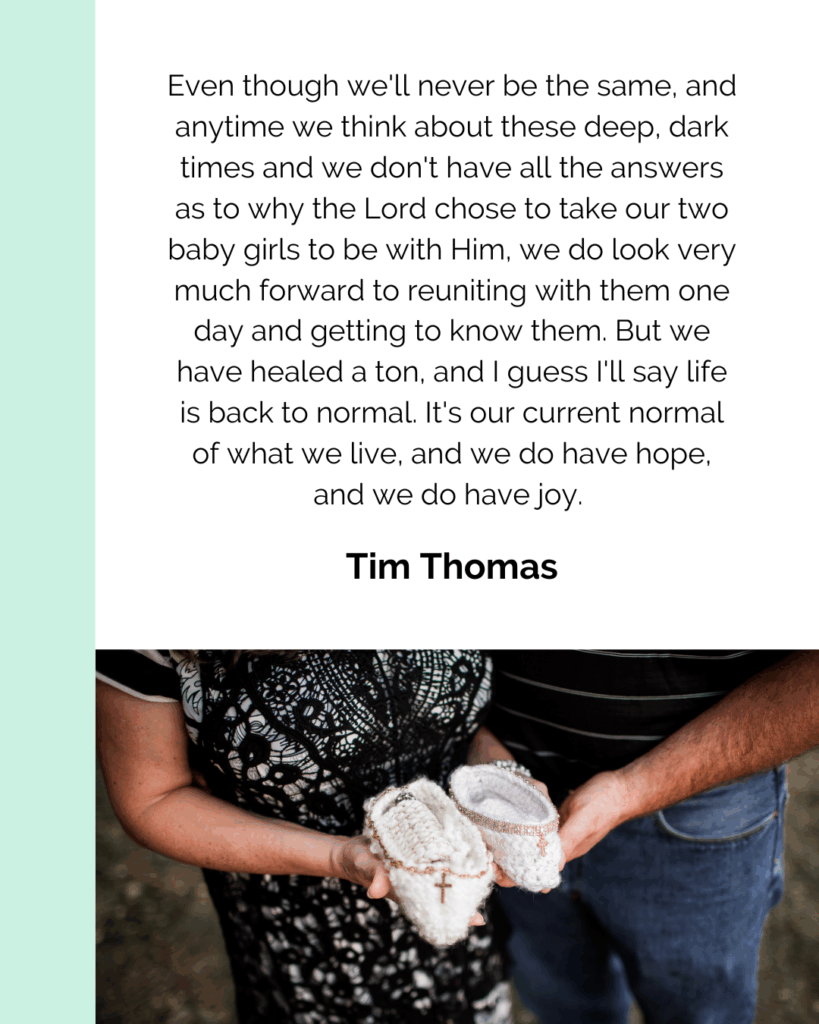
[00:25:10] And even though we’ll never be the same, and anytime we think about these deep, dark times and we don’t have all the answers as to why the Lord chose to take our two baby girls to be with Him, we do look very much forward to reuniting with them one day and getting to know them. But we have healed a ton, and I guess I’ll say life is back to normal. It’s our current normal of what we live, and we do have hope, and we do have joy.
[00:25:37] And so to those that are in the midst of that deep, dark place, it doesn’t feel right now like you’re going to ever have hope or joy again, but you will. Just keep looking to the Lord. Don’t take your eyes off of Him.
[00:25:52] And don’t let your marriage fall apart. It’s important that you stick together as a couple. It’s really God first and then your spouse second. You’ve got to keep those priorities, or it’s going to be harder for you.
Yolanda Thomas: [00:26:04] Yeah, I think we both really leaned into the sovereignty of God. I love the quote by C. H. Spurgeon that says, “When you go through a trial, the sovereignty of God is the pillow upon which you lay your head.”
[00:26:17] And so I think that helped us be united, and we were strengthened together because we didn’t understand what God’s plan was. We couldn’t see the good in it. And to this day, I don’t think we’ll see the good until Glory. But we were united in that we knew that He had a plan and one that was going to give us a future and a hope, even though we didn’t understand His ways, because His ways are higher than our ways.
Ashley Opliger: [00:26:42] Absolutely. And Yolanda, I don’t know if you remember, but after my dad went to Heaven, you texted me the quote about the pillow of God’s sovereignty, and you had texted that to me in between when I turned my first draft of my book and final draft and, actually, I don’t know if it was my second or my third or fourth draft, but the final draft, and I included that in Cradled in Hope.
[00:27:05] I don’t know if you’ve noticed that or not, but that quote is now in Cradled in Hope, and I learned about it from you. So thank you for inspiring me to share that, because that was so comforting for me when you don’t have answers.
[00:27:19] And the same was true for me with my dad and with Bridget. Even if you know why it happened, like for you with Abundynce, having a medical answer, you still have to ask the question, “Well, why did You allow it, God? Why did You allow that medical condition to happen?” And so ultimately resting in His sovereignty and His plan, and as Tim said, focusing our eyes on Heaven and on Jesus.
[00:27:44] And so thank you for that reminder of also knowing that the family that you knew that was 10 years ahead of the journey for you, you saw them then, and now that’s you 10 years out, and that God was faithful and has brought so much healing and joy back to your lives.
And Tim, I love the reminders that there’s so many people who are listening who are in the freshness of it, and they don’t believe that it’s going to get better or that they ever will have joy again.
[00:28:11] I remember strongly feeling that. It was never going to get better. And it’s amazing what time can do, coupled with the healing of Jesus and a strong support system, Christ-centered community around you. I believe that’s so important.
Ashley Opliger: [00:28:26] We hope you’re finding encouragement in this episode so far. We want to take a moment to share some resources our ministry offers to support grieving moms like you.
On our website, bridgetscradles.com, you’ll learn more about our nonprofit and find many hope-filled resources, including free e-books to help you plan a memorial or funeral service for your baby, meaningful ways to honor your baby in your heart and home, and gentle guidance for navigating difficult days like due dates, Heaven Days, and holidays.
We invite you to join our community of grieving moms through our Christ-centered support groups, offered both in-person at our headquarters near Wichita, Kansas, and virtually through Hope Online. These gatherings provide a place to find comfort, connection, and biblical hope alongside other moms who understand your pain.
You can view upcoming dates and sign up on our website. While you’re there, we’d also be honored for you to share your baby’s story with us.
For ongoing support, we welcome you to join our private Cradled in Hope Facebook group—a safe space for grieving moms to find friendship and walk their healing journey together.
To stay connected with us and receive faith-filled encouragement, follow us on Facebook and Instagram at @bridgetscradles, @cradledinhope, and my personal page @ashleyopliger.
Now, let’s get back to the episode.
Ashley Opliger: [00:29:47] Speaking of Christ-centered community, you alluded to this earlier, Yolanda, when you were talking about Tim having your back, and some hurt that you experienced in the church, largely due to people that you knew and trusted that you expected to show up in a certain way to support you through this grief and didn’t.
[00:30:07] And I think that’s a very common experience for all of our listeners who have walked this journey of pregnancy and infant loss, whether it’s people in their church or friends or family members, that they just are shocked at how little support or how the things that they’re saying, whether it’s the Christian cliches and platitudes or not saying anything at all, because they’re uncomfortable to bring it up.
[00:30:32] So would you share about your journey with church hurt and how that affected your faith in that time, and also just your outlook on life?
Yolanda Thomas: [00:30:41] Yeah, well, I first need to say that all of the people that we went to church with at the time are godly people. And I know that in their heart of hearts, I knew that they wanted to be there for me. I knew that they wanted to support me. I knew that they cared for me and loved me, and they prayed for me. And actually, I have restored all my relationships with the ones that were strained, and God has brought beauty for ashes.
[00:31:07] But I will say it was a very hard time. I remember driving to church with a lot of anxiety, almost to the point of a panic attack, just because I felt that a lot of people didn’t know what to say and so they didn’t say anything, or they didn’t want to enter into my grief with me. I felt like that they wanted to wait until I got better, wait until I was done grieving, and then they would enter in and sit with me.
I think, again, my situation they had seen, when we first started going to the church, I lost my mom after five weeks of cancer diagnosis. And so I was doing random acts of kindness and just trying to process my grief with that loss.
And then it wasn’t too long after that we lost Abundynce and Joyana, and I think maybe they had an expectation that I would maybe handle it differently, and I felt like they had an expectation, and maybe they didn’t, but I just felt like there was this expectation that I need to handle it with all joy and count it all joy and grieve with hope.
[00:32:14] And I was grieving with hope. I mean, we have the hope of Heaven, but we still grieve, right? We grieve with hope, but we still grieve.
And so I didn’t really feel the freedom to grieve how I needed, andjust be sad. I was sad, and I was broken. They were happy to drop off a meal and to ask me about my other children. But nobody really wanted to get into the messiness of the grief that I was experiencing.
[00:32:45] And so that was really hard for me and, again, was thankful for the dear friends that I did have who did show up, and they just sat with me. And I remember one of my sweet mentors who is now with the Lord, she came to visit me, and I was just in tears telling her how broken I felt.
[00:33:03] And I’ll never forget what she said to me, she said, “Yolanda,” she said, “even like a stained glass window is broken, when Christ’s light shines through it’s still beautiful.”
And that was so encouraging to me because I just felt like a broken mess. But she really helped me to realize that even in my brokenness, that God could use me and I could still shine the light of Christ. And so that was very helpful to me.
Ashley Opliger: [00:33:29] Yolanda, I have seen how Christ has been shining His light through your grief journey because you have been one of the people in my life through my grief, especially after the loss of my dad, that has been so supportive.
[00:33:43] And I think what’s unique about you and is really [a] hard thing for most people to understand is the long suffering of grief. A lot of people will show up at the beginning, after the funeral, they’ll show up with meals. They’ll do the things at the beginning, but then over the course of weeks and months, that support just tapers off.
And something that’s very unique about you and the way that you love and support people that you’re close to is that you show up and you’re consistent, even as the months turned to years.
[00:34:15] And I’ve just been so grateful for how you’ve remembered me and my mom, who, you’ve been walking this journey with my mom as she’s become a widow, and I’ve just been so grateful for you in the ways that you’ve shown up.
[00:34:28] And I know that the Lord has used your own suffering and your own pain of how you weren’t necessarily loved or cared for in those moments. I think that has made you more compassionate and empathetic for other people, and so I see that light shining through the stained glass in you. And I would love for you to just talk about how your own grief has deepened your compassion for walking with others through loss and how that’s changed over time.
Yolanda Thomas: [00:34:55] Yeah, I think I was just really inspired by the few people that really did get it right. They really sought to minister to me, to show up, to listen, and to not be afraid of the mess that grief is. And so I think over the course of losing my mom and then losing the babies, I think that God has just given me a deep compassion for people that are hurting.
[00:35:25] And I don’t get it right all the time. I’m sure that I say the wrong thing and mess up, but I guess He’s taken away the fear and the hesitation that I have, or that most people might have when they know that someone is really deeply hurting. I think a lot of people want to avoid those situations, but God has just given me a compassion to just not be afraid to be there to hug or to say how sorry I am, or to try to put together a gift basket or something to just let people know, because I know how much that meant to me.
And so I think too, I really felt like after our losses, that the Church does a great job of rejoicing with those who rejoice. But I really just felt like there is a really deep need for the Church to do a better job of weeping with those who weep, and so I just really wanted to do that.
Ashley Opliger: [00:36:16] You do it so beautifully. And I think to your point, you said God’s given you that boldness and willingness to step into the hard. And the term that came to mind as you were saying that is like a holy bravery of saying, “You know what? I am going to enter into this. I don’t know how it’s going to be received, but I am going to step in, and I’m willing to be in the hard and the messy.”
[00:36:41] And I think that’s what grieving people want is to feel seen and to know that their grief is validated. That’s one of the hardest parts of grief, is when you’re lonely and you’re isolated, and the world is not validating your grief, and you’re feeling like you’re being pushed along to just get back to normal.
Like you said, so many people were ready to resume their friendship once you were quote unquote “better” and it’s, “I need a friend in the valley even more than I need a friend on the mountain.” It’s the valley friendships that I treasure in my life, and I thank you for being one of those friends to me.
Yolanda Thomas: [00:37:17] Yeah, I think that one thing that was so hard for me was just that so many people are quick to say, “I know exactly how you feel,” and I think that’s something that people need to think twice before they say that because everybody’s grief journey is so different and unique.
[00:37:35] And you can’t say to somebody, “I know exactly how you feel.” You have no idea. You may have experienced your own grief and your own loss, but you can’t say you know exactly how someone else feels. And so that was something that I really struggled with and that I try really hard.
[00:38:00] I just met with a young mom yesterday that had lost her 16-week baby boy, and even though I did experience something similar, I didn’t experience exactly what she went through, and I didn’t lose her baby. I lost my baby. And so I think just have to be careful how we say things and what we say.
[00:38:16] And your guide on your website, I think it’s called Supporting a Loved One After the Loss of a Baby is wonderful. And I’m just so thankful that over the last 10 years, you have done such an amazing job on your website, equipping people to be able to walk others through this, because I felt like the Church and believers missed the mark when I went through it, some of them. Not all of them. But I just felt like we as a Christian community can just do much better. We can just do a better job.
[00:38:49] And so I really feel like your website and that specific ebook is very helpful in helping people know what to say and what not to say, what to do and what not to do. It was very helpful.
Ashley Opliger: [00:39:00] Thank you for saying that. And yeah, we actually do have a lot of people that reach out to us saying, “My friend or family member,” or “my sister, my grandson and daughter-in-law,” whoever it is, “just lost a baby. What can I do?”
[00:39:13] And so we built that out on our website and ended up turning that into an ebook that’s a free resource that you can download, has a lot of different ideas on how to support someone that you love in the early days of grief. But then also we talk about years later and how to be intentional about the long suffering of grief.
[00:39:34] And then we also have a gift guide as part of that, that has some ideas that you can give a gift on a grieving parent’s due date or Heaven Day or something for Christmas that’s personalized to their baby or something that would be very meaningful to them.
[00:39:52] I think that’s another thing, a lot of times people will ask is, “What can I get someone? I want to do something special for them, but I don’t know what that is.” And so we’ve tried to compile our most recommended ideas on there. So thank you for bringing that up.
And I’m sorry that you walked through that journey yourself, but I know that it has definitely made you a better, more caring grief supporter in how you show up for your friends and family members. And I’m glad that we could have this conversation because I think there’s a lot of people that want to do better but don’t know how.
Yolanda Thomas: [00:40:21] Yes. Thank you.
Tim Thomas: [00:40:22] One thing that I’ve been thinking about is that you don’t want your babies to be forgotten. And so you tend to feel like, “Well, if I’m holding onto the grief or whatever, I’m valuing them, or I am validating their lives.”
And I think once you mature a little bit through your grief, you realize that they’re not going to be forgotten. And in many ways, being hopeful and joyful and thankful for the fact that the Lord actually chose you and your wife or your spouse if you’re a husband and wife, or whichever one you are, He used the two of you to bring a soul, an eternal soul into the world.
[00:40:05] And yes, you didn’t get to have the toddler years and child years and teenage, and walk them down the aisle, and all the things that you would cherish to do with your babies in this world. But that is an eternal soul that is in Heaven with Him, and there’s no reason to be sad or feel like the only way that life is valued is because of you remembering them in a grieving way.
There’s a lot of joy to be held from that life and I think that’s important to remember. And I think some people get hung up holding onto their grief, thinking that they can’t move on or live and enjoy the life the Lord has given them.
[00:41:49] There’s different reasons for that, but just maybe they’re not almost putting themselves on a guilt trip. “Well, I can’t go be happy or have fun or enjoy my other children or whatever, because now I’m not remembering or being thankful for this precious soul.”
[00:42:02] But it’s quite the opposite. He chose, and His timing is something we don’t understand, and He chose for that baby to live in this world for however many days and weeks it was in the mother’s womb. And now it’s in Heaven with Him. And your babies didn’t have to experience many of the pains and suffering of this world. And they got the fast track; you go to Silver Dollar City, you ride the fast track so you can get right up the front of the line, and they got to take that.
[00:42:29] So I think if someone out there that is struggling to feel like, “I’m grieving because I don’t want their memory to be lost,” and I really think that the memory won’t be lost.
And one of the things we did is, it wasn’t very pricey, but we bought a little commemorative, granite, engraved stone with our babies’ pictures and names on it. And we have that in our kind of memorial garden. And so that’s one way that we’ve chose to remember our babies, along with the precious cradles that we have proudly displayed in our house. But that’s the only other thought I had.
Ashley Opliger: [00:43:03] Well, Tim, thank you. I think that’s a very important point to make because I do think that there’s a guilt feeling of quote unquote “moving on” from grief, or it’s almost like you feel as though you’re betraying your baby by moving forward and having joy.
[00:43:20] And to your point, grief is love. It’s an extension of love. But that grief doesn’t have to express itself in sadness the rest of our lives. And we can honor our babies with joy and with turning our pain into a purpose and having a legacy for them by using our grief for good and doing good things in Jesus’ Name and building the Kingdom.
[00:43:41] Because you’re right, they got the fast track. They skipped over the brokenness of this world. They’re in Heaven. I don’t think if they were offered the opportunity to come here, that they would want to. We’re the ones that are stuck here on this earth, and unfortunately, we have to wait our time.
[00:43:56] But there’s work to be done here as followers of Jesus to live out our calling as His disciples. And so I think that having that Heaven-minded perspective that yes, you have created a human soul that lives for eternity in Heaven. And you’re going to get to spend thousands and thousands of years, and it is not a loss to your family, but a gain. So thank you, Tim, for ending this podcast on such a bright, hopeful message. Would you be willing to close us in prayer?
Tim Thomas: [00:44:25] Sure.
Heavenly Father, I thank You so much for the blessing of Bridget’s Cradles. I thank You for Matt and Ashley and all the sacrifices they have made as a family and as a couple, and just the call that You’ve put on their lives to serve families that have lost babies.
And I just pray that You would continue to bless the ministry. I pray that You would continue to use it to bring healing and hope to husbands and wives and couples that have lost a precious baby. And Lord, I just pray that You would give them wisdom as they continue to seek out the best ways to get the ministry out to various hospitals.
And Lord, there’s just so many hurting people and so many people that can use the resources that are offered there. So I just pray Your continued hand of blessing on the ministry.
I thank You for the opportunity Yolanda and I were given to share our story, and I pray that You would use it in some form or fashion to minister and above all, Lord, to bring glory to Your Name and to point others toward You. We ask all these things in the precious Name of Your Son. In Jesus Christ’s Name we pray. Amen.
Ashley Opliger: [00:45:38] Amen. Thank you so much, Tim and Yolanda. It’s a joy to have you.
Yolanda Thomas: [00:45:43] Thank you for having us. Ashley. Love you, friend.
Ashley Opliger: [00:45:47] Thank you for listening to the Cradled in Hope Podcast. We pray that you found hope and healing in today’s episode.
Don’t forget to subscribe so you don’t miss new episodes when they release each month. You can also find this episode’s show notes and a full transcript on our website at bridgetscradles.com/podcast.
Be sure to sign up for our email list on our website, so that we can keep you updated on upcoming podcast episodes, support groups, and other hope-filled resources.
You can also purchase my book, Cradled in Hope, wherever books are sold. It’s a biblical guide for grieving moms to find hope after miscarriage, stillbirth, or infant loss. Written from the depths of my own heartbreak, I share vulnerably about losing my daughter, Bridget, and how God met me in my grief. Through Scripture, theology, and soul-deep reflections, Cradled in Hope offers biblical wisdom, practical guidance, and the eternal hope of seeing your baby again in Heaven through faith in Jesus.
To accompany the book, I’ve also created the Cradled in Hope Guided Journal—a beautiful companion that includes space to write your responses to the discussion questions, full Scripture passages from each chapter, and additional reflection pages and guided charts to help you process your grief and draw you closer to Jesus. You can download the free digital version on my author website at AshleyOpliger.com/Journal, or order the printed version on Amazon if you prefer to write by hand.
Are you looking for ways to use your grief for good? Visit our website to learn how you can volunteer or donate to Bridget’s Cradles in memory of a baby in Heaven.
Do you want a quick way to make an eternal impact? Share this episode with a friend or leave a review on Apple Podcasts to help more grieving moms find the same comfort you’ve received here.
Thank you so much for listening and sharing. Until next time, we will be praying for you. And remember, as Jesus cradles our babies in Heaven, He cradles us in hope. Though we grieve, we do not grieve without hope.
I have a fancy professional bio here, but what is most important for you to know is that my first and only daughter, Bridget, went to Heaven and Jesus was the only One who could put the shattered pieces of my heart back together. Maybe your heart is broken too?
If so, I'm here to be your friend and walk with you on your grief journey. More importantly, I'm here to point you to Jesus, the only One who can heal your heart and promise you eternity with your baby in Heaven. Hold my hand, friend, and let's start this journey together.
I'm a grieving mom who found comfort in Christ.
Welcome, I'm so GlaD You're Here





Spotify
Apple
Ways To Listen
Hosted by Ashley Opliger, this podcast offers Christ-centered comfort to moms grieving the loss of a baby in Heaven. Each episode is rooted in Scripture and points your heart to the truth of the Gospel, the presence of Jesus, and the eternal hope of being reunited with your baby in Heaven.
Listen to Our Podcast
welcome to cradled in hope


Donate Online
Make an eternal impact. Your donation comforts grieving families with cradles, support, and the hope of Christ.

Find a Community
You don’t have to walk this road alone. Join a Christ-centered community of moms who understand your grief.

Read the Book
Discover comfort, hope, and biblical encouragement in Cradled in Hope, written by Ashley Opliger for grieving mothers after baby loss.


Christ-Centered Comfort and Guidance for Grieving Families
Honor your baby’s memory with kindness. Explore 50 thoughtful ideas—plus a free customizable RAK card to share their legacy of love.
Random ACts of Kindness in Memory of a Baby in Heaven
Find meaningful ways to honor your baby on birthdays, due dates, and holidays—offering remembrance through cherished traditions.
Honoring Your baby on Milestones and Holidays
Offer support to a grieving parent with practical ways to help and 12 heartfelt gift ideas designed to bring comfort during deep loss.
Supporting a Loved One After the loss of a baby


Navigate life after loss with gentle guidance for grieving, healing, and finding hope in the midst of heartbreak.
Grieving and Healing After the Loss of a Baby


